The Quiet Mathematics of Repeating Patterns in Tile and Cloth
The quiet mathematics of repeating patterns makes tile and cloth easier to read: learn how simple rules, rotations, and shifts shape a surface.
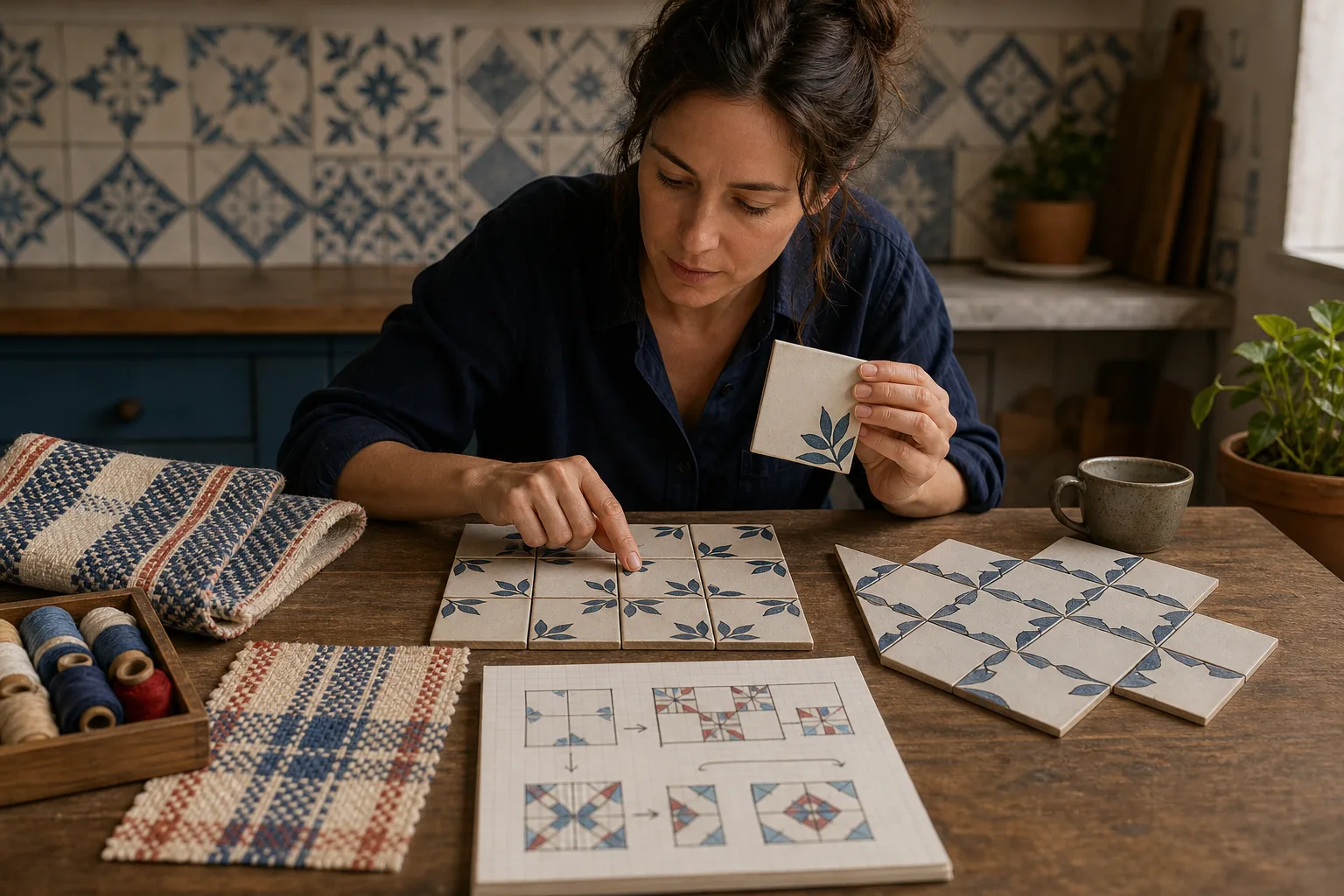
The common mistake with repeating patterns is to treat each mark as a separate decoration. That misses the quiet mathematics of repeating patterns: a small set of choices can shape an entire tiled floor or woven cloth. Once you notice the unit that repeats and the rule that moves it, the surface becomes easier to understand, compare, and design.
Three approaches are especially useful: look for a single tile that can be copied, track how a shape changes as it repeats, or read the pattern as a larger grid of neighboring forms. Each reveals something different. The best one depends on whether you are trying to recognize a pattern, explain its structure, or make a new one.
What is the repeating unit?
Start with the smallest piece that contains the pattern’s essential arrangement. On a kitchen backsplash, that might be one square tile. In a woven dish towel, it may be a small group of colored threads. The unit does not have to be the smallest visible shape; it needs to be the smallest piece that can repeat and still reproduce the design.
This is the copy-and-shift approach. Imagine a plain square tile with a blue leaf painted near one edge. If every tile has the same leaf in the same position, placing the tiles side by side makes a field of repeated leaves. The tile itself is copied without changing its orientation. The joining edges determine whether the copies meet neatly or leave a visible break.
To find the unit, look for a boundary that could be drawn around a section and moved to another section without changing the arrangement. A grout line can make a tile boundary easy to see. In cloth, the unit may cross what looks like a natural visual boundary, so follow the colored threads rather than relying on a printed motif alone.
This approach suits a first reading of a pattern, or a design task where the material already comes in separate pieces. It helps answer practical questions: How many tile shapes are involved? Does the printed motif continue across the grout? Is a repeated section easy to align? Its limitation is that it can hide the movements inside a more intricate design.
What changes as the unit repeats?
Repeated forms do not always stay in the same position. A tile may turn, reflect, or slide before the next copy appears. The transformation approach follows those changes rather than treating each instance as an identical stamp.
Consider a square motif with a red corner. Copying it without turning keeps every red corner in the same relative position. Turning alternate copies can make the red corners face inward toward one another. Reflecting a motif across an edge creates a reversed version, much as a letter appears backward in a mirror. Sliding it preserves its orientation but moves it along the surface.
These choices affect the feel and continuity of a pattern. A rotation can make a design appear to bloom around a point. A reflection can form a line of symmetry. A plain slide tends to create a steady direction, like stripes that continue across a fabric. The same basic shape can therefore produce very different surfaces under different rules.
When reading an existing pattern, mark one distinctive detail in the motif, such as a colored dot or a leaf tip. Follow it from one copy to the next. If it moves to the opposite side, the motif may have been reflected; if it shifts around a center, it may have been turned. A repeating shape can be hard to track when every side looks identical, so use a feature that makes orientation visible.
This approach suits someone comparing designs or trying to explain why a pattern feels balanced, directional, or lively. It is also useful when a maker needs to decide whether pieces can be cut in one orientation or must be turned. But tracking transformations can become abstract if the surface is viewed only as a collection of motions.
How do neighboring shapes make a larger design?
The third approach begins with the spaces between repeated forms. A tile’s edge may fit the next tile so that the visible shapes create a second pattern: stars between squares, flowers between diamonds, or a zigzag running along a seam. The design is then not just a row of repeated units. It is a network of relationships among neighboring shapes.
Look at a patterned floor from a little farther back. A single tile may be difficult to recognize, while the larger arrangement appears as a chain of diamonds or a field of interlocking shapes. The grid approach asks which edges meet, which corners gather, and what forms emerge at those meeting points. It can reveal structure that a close inspection of one tile misses.
Woven cloth offers a related view. Individual threads pass over and under one another, but the visible motif depends on their repeated arrangement. Following only one thread tells you where it goes. Looking across several threads shows how the weave creates a broader band, check, or stepped shape. The pattern is carried by both the pieces and their relationships.
This approach suits people who want to understand how a design holds together across a whole surface, particularly when the repeated unit is not obvious. It helps with choices about borders, corners, and transitions between areas. Its drawback is scale: details that matter in a single tile or thread can disappear when you focus only on the larger grid.
Which approach should you use?
Choose the copy-and-shift approach when the material has clear, repeated pieces and you need to identify the basic unit. Choose the transformation approach when repeated motifs change direction or orientation. Choose the grid approach when the larger arrangement matters more than any one piece, or when the spaces between shapes seem to form their own design.
These are not competing explanations. They are different views of the same surface. You might identify a tile unit first, notice that each alternate tile turns, then step back to see the diamonds created by their meeting edges. Moving between views is often more revealing than trying to force one description to explain everything.
Say you are planning a small backsplash with square tiles and a leaf motif near one corner. If your priority is easy alignment, choose a design that repeats the leaf in one orientation and check that the motif meets cleanly at the grout lines. If you want a more interlocking look, turn every other tile and inspect how the leaves and empty spaces meet. A paper sketch with colored squares can show the expected arrangement before you commit to the layout.
A useful choice also depends on the material. Factory-cut tiles make the unit and its edges easy to compare. A printed fabric may permit a continuous design that crosses the apparent unit boundary. A handwoven cloth may depend on thread direction, which can affect how a repeated stripe aligns at a seam. Ask what the material allows before settling on a rule.
What questions help you read a repeating pattern?
How can I find the smallest repeating unit?
Look for the smallest section you can shift or copy while preserving the whole arrangement. Compare its edges with nearby sections, and include any detail needed to make the pattern continue correctly.
What is the difference between reflection and rotation?
A reflection reverses a motif across a line, like its mirror image. A rotation turns it around a point, keeping its handedness while changing which direction it faces.
Can one surface have more than one repeating unit?
Yes. A tile may repeat by itself, while a larger group of tiles repeats as a second unit. The useful unit depends on the question: piece layout, motif direction, or the structure of the full surface.
Why do the gaps between tiles matter?
Gaps and meeting edges can form shapes of their own, such as diamonds or crossing lines. Looking at those spaces helps explain the larger pattern when the individual tiles seem plain or repetitive.
How can you describe the rule clearly?
A good description names the unit, the movement, and the result. For example: “A square tile repeats in rows; alternate rows shift by half a tile, making the vertical joins stagger.” That is more useful than saying only that the floor has a repeating design. It gives another person enough information to imagine how the parts meet.
When you sketch a pattern, draw a boundary around the unit and add an arrow to show how it moves. Use a curved arrow if the motif turns, or a line if it reflects. Then mark one or two neighboring copies. A simple drawing can expose a rule that is hard to explain with words alone.
For a fabric swatch, pencil a small grid on tracing paper laid over the design, rather than marking the cloth. Follow a thread or motif across the grid, and note where colors change or shapes reverse. For tiles, arrange paper squares on a table and rotate or slide them before making a final choice. These tools keep the material intact while making the pattern’s logic visible.
There is no need to name every formal category to read a pattern well. The practical questions are more direct: What repeats? What happens to it as it repeats? What do its neighbors create? Those questions connect a small detail to a larger arrangement, whether you are looking at a woven towel, a mosaic, or the paper pattern for a craft project.
The quiet mathematics of repeating patterns is useful because it turns a surface into a set of choices you can see. Begin with the unit when pieces must align, follow transformations when motifs change direction, and step back to inspect the grid when the whole design matters. If a pattern still feels confusing, trace one distinctive feature and watch where it goes; its path often reveals the rule before the full design does.